Google+
Showing posts with label android. Show all posts

Thursday, 28 November 2013

CyanogenMod app Removed From Google Play


The CyanogenMod app to more easily install the open-source Android variant only lasted two weeks on Google Play.

CyanogenMod developers removed the installer because Google said it violates Google Play developer terms, but the startup has hopes it'll be restored. Cyanogen explained the installer removal in a blog post Wednesday:

Jedi Knight II on your Android


Will wonders never cease? The best lightsaber-fighting Star Wars game, Jedi Knight II, can now be played on your Android smartphone -- though with some caveats.

Developer Beloko Games has ported a customized version of the Jedi Knight engine over to ARM, which means all you need to do is get the game content from the Steam version (US$6.99) and copy the files over to your smartphone to get it working.

Now, if you're thinking this sounds a little dodgy, rest assured it's not. The game's source code was released under GPL, allowing the developer to compile the engine to work for Android devices. He is, however, not allowed to charge for the copyrighted content: i.e. the game assets.

Before you grab the app (US$1.99), the developer states that you'll need at least a dual-core device to play the game. And if you're thinking your lightsaber fighting skills are going to suck due to touchscreen controls, well the app has support for Xbox and PS3 controllers.

Source: Cnet

Wednesday, 30 October 2013

Is Google trying to create the world’s first mass-production smartwatch?


Google could be making the world’s first mass-production smartwatch. With the WSJ on Google’s behind, this may have spurred a few rumors about their smartwatch. WSJ reported that Google’s smartwatch could be months away according to the manufacturers. It seems like Taiwan has been in talks with top manufacturers in producing a smartwatch, with the Mountain View Company as one of them.

Tuesday, 29 October 2013

Nvidia Shield 4.3 Jelly Bean Update Adds more than 1000 Android games

Nvidia has opened its Shield gaming device up to the universe of Android games, adding console support to thousands of games originally designed for touch screens.

The Santa Clara, Calif., graphics chipmaker said the Shield "Gamepad Mapper" allows users to create their own custom controls for thousands of games in the Google Play store, or users can use Nvidia's default profiles -- automatically downloaded from the cloud -- that are available for hundreds of top touch-based Android games. The new titles with Shield controller compatibility include NBA Jam and Angry Birds.

The changes are available immediately through an over-the-air software update.


Nvidia unveiled Shield during the Consumer Electronics Show in January. The device runs Android, but it also includes gaming-specific features, most notably its design. The system looks more like a game controller than a tablet, and Nvidia recently said that Shield was selling out in stores. Early on, however, Shield faced limitations with the number of games that it supported through its game console-like controller. The expansion released Monday should help boost the device's reach.

Samsung Galaxy Round with Curved Display


Samsung Galaxy Round with curved display: 'a major and very important new display technology.'(Credit: Samsung)

The curved display on Samsung's Galaxy Round offers distinct advantages in reducing reflections and the high glossiness of flat displays, according to a report out Tuesday.

"There is widespread misunderstanding regarding curved displays. They aren't simply a marketing gimmick as has been widely reported," Raymond Soneira, president of DisplayMate Technologies, a firm that does display testing and evaluation, said in a report published Tuesday.

"In fact, curved screens are a major and very important new display technology innovation," he said in his introduction to the report, which is based on his own in-house testing of a Galaxy Round.

Soneira's findings about Samsung's curved 5.7-inch OLED display include:

Concave screen: The curvature on the Galaxy Round is fairly small -- the left and right edges of the screen are just 2.66 mm (0.10 inch) higher than the center. "So the effect is subtle, but it's very important."

Improved screen privacy: Screen privacy is improved because the curvature makes it harder for other people to see the screen.

Lower reflectance: A curved screen cuts down on reflections. The curvature directs reflected ambient light "coming from behind away from the viewer's line of sight. This is very important because you want to minimize the amount of ambient light that is seen reflected off the screen." The screen also magnifies the size of objects reflecting off the screen which "substantially cuts down on the interference of light reflections."

Glossiness reduction: Flexible OLED displays are manufactured using a flexible plastic substrate, "so they don't have the glossy cover glass used on virtually all existing mobile displays." And without the cover glass, the OLED display appears to be right on the surface of the screen, which is "visually striking."

The Galaxy Round -- which has the same-sized 5.7-inch display that is on the Galaxy Note 3 -- also features a Qualcomm Snapdragon 2.3GHz quad-core processor, 32GB of internal storage, 3GB RAM, and an up-to-64GB microSD card slot.

As Source's Reviews noted, it's not clear how much the Round will cost. But it does have specs similar to the Galaxy Note 3, which starts at about $300.

Tuesday, 22 October 2013

Micromax Canvas Magnus and Canvas Turbo leak

Micromax, a company popular for the excellent value for money its Android smartphones delivers, is preparing to launch two new smartphones - the Canvas Turbo and the Canvas Magnus. Both phones have their specs leaked today hinting at imminent launch.

Starting with the Micromax Canvas Turbo, which has Hugh Jackman as its main promoter. The smartphone is built around a 5" 1080p display - a first for the Indian phone manufacturer. Under the hood, the Canvas Turbo rocks a 1.5GHz quad-core MediaTek MT6589T chip with a 357MHz GPU and 1GB of RAM.

Internal storage is suggested to be 32GB and is going to be expandable with the on-board microSD card slot that supports up to 64GB cards. The Turbo runs Android 4.2 Jelly Bean with rumors suggesting that Micromax will release an Android 4.3 update shortly after the market launch.

At the back, the Canvas Turbo sports a 13MP autofocus camera with LED flash, while the front a 5MP snapper takes care of video chatting. Naturally, the Canvas Turbo packs dual-SIM functionality as well.

As for the Micromax Canvas Magnus, it's a mid-range smartphone running Android 4.2 Jelly Bean. The leak suggests it's going to flaunt a 5" 720p display and is going to be powered by an undisclosed 1.5GHz quad-core processor (probably the same as the Canvas Turbo) with 1GB of RAM.


At the back, there's a 12MP autofocus camera with LED flash, and a 5MP front-facing camera above the display. Popping the back cover is rumored to reveal a 2,000mAh battery as well as a microSD card slot.

Pricing and availability of both the Canvas Turbo and Canvas Magnus isn't officially confirmed just yet. Expected release is tipped for November, but pricing remains anyone's guess at this point.

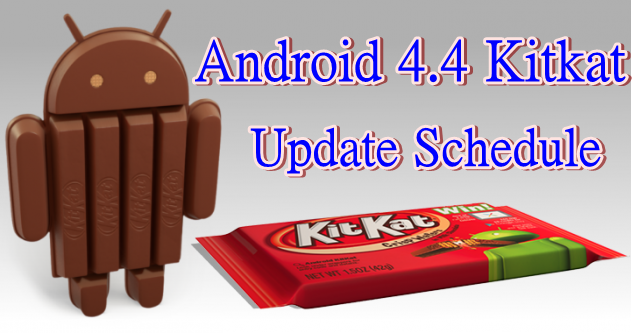
Samsung, Sony, HTC, LG Phones Android 4.4 Kitkat Update Schedule

We outline Samsung, Sony, HTC, Nexus LG Android 4.4 Kitkat update schedule for phones & tablets, expected date of arrival.

Android announced 4.4 Kitkat all of a sudden and to surprise all it has adopted the name of popular chocolate selling company in the world by Nestle. During the unveiling of it, Nexus 5 too was leaked. Neverthless the next Nexus device will be Nexus 5 and it will be out with Android 4.4 out of box. In short there is no phone right now with Android 4.4 kitkat version.Android 4.4 Kitkat update
Some of the recently launched flagship high-end smartphone & tablets will receive Kitkat update and in this article we outline some of the devices.

Samsung Android 4.4 Kitkat Update Schedule

Samsung leaked out internal document called Knox, made us to clearly predicts what Galaxy devices will be update to Android 4.4. The device list follows as -
Phone ModelExpected Dates
Samsung Galaxy S4December 2013
Samsung Galaxy Note 3December 2013
Samsung Galaxy S3Q1, 2014
Samsung Galaxy S4 MiniQ1, 2014
Samsung Galaxy Note IIQ1, 2014
Samsung Galaxy Mega 5.8 & 6.3Q1, 2014
Samsung Galaxy Note 10.1 2014 editionQ1, 2014
Samsung Galaxy Tab 3Q1, 2014

Google Nexus Android 4.4 Kitkat Update

Google has prioritized Nexus devices when it comes to updates. With launch of New Nexus 7 tablet with Android 4.3 Jelly Bean and at the same time all the Nexus devices are ported to Android 4.3 Jelly Bean. Here is the list of Nexus devices with Android 4.4 Kitkat update schedule –
Phone Model
Expected Dates
Nexus 4December 2013
Nexus 7December 2013
New Nexus 7December 2013
Nexus 10December 2013

Sony Android 4.4 Kitkat Update Schedule

Here is Sony Xperia phone 4.4 Kitkat update scheduled -
Phone Model
Expected Dates
Sony Xperia ZQ1 2014
Sony Xperia Z UltraQ1 2014
Sony Xperia Z1Q1, 2014
Sony Xperia ZRQ1, 2014

HTC Android 4.4 Kitkat Update Schedule

Here is HTC Android 4.4 Kitkat update schedule -
Phone Model
Expected Dates
HTC OneQ1 2014
HTC One MiniQ1 2014
HTC One MaxQ1, 2014

LG Android 4.4 Kitkat Update Schedule

And here is LG Android phone which might expect update to 4.4 Kitkat -
Phone Model
Expected Dates
LG G2Q1 2014
LG Optimus G ProQ1 2014
LG Optimus G Pro LiteQ1 2014
LG GPad 8.3Q1 2014
The expected time frame given above is just what we expected, although some of them are taken from leaked sources.

How to easily root an Android device

Free Windows utility Kingo Android Root makes it a snap to jailbreak just about any Android smartphone. Here's how to use it.

Rooting is the Android equivalent of jailbreaking, a means of unlocking the operating system so you can install unapproved (by Google) apps, update the OS, replace the firmware, overclock (or underclock) the processor, customize just about anything, and so on.

Of course, for the average user, rooting sounds like -- and can be -- a scary process. After all, "rooting" around in your smartphone's core software might seem like a recipe for disaster. One wrong move and you could end up with bricked handset.

Thankfully, there's a new Windows utility that makes rooting a one-click affair: Kingo Android Root. It's free, and based on my initial tests with a Virgin Mobile Supreme, it works like a charm. (Be sure to check the compatibility list before you proceed, keeping in mind that although the Supreme wasn't on it, the utility had no problem with it.) Here's how to get started.

Step one: Download and install Kingo Android Root.

Step two: Enable USB debugging mode on your phone. If it's running Android 4.0 or 4.1, tap Settings, Developer Options, then tick the box for "USB debugging." (You may need to switch "Developer options" to On before you can do so.) On Android 4.2 and later, tap Settings, About Phone, Developer Options, and then tick USB debugging." Then tap OK to approve the setting change.
Step three: Run Android Root on your PC, then connect your phone via its USB sync cable. After a moment, the former should show a connection to the latter.
Step four: Click Root, then sit back and wait while the utility does its thing. The aforementioned Supreme took all of about two minutes, including the automated reboot at the end.
And that's all there is to it. If you decide you want to reverse the process, just run Android Root again, connect your phone, then click Remove Root.
With that done, now you can take advantage of options like USB On-the-Go to make your unexpandable phone expandable. Hit the comments to share your favorite tricks for a rooted Android phone.

Saturday, 19 October 2013

Motorola Moto X review: A comfy Android with mass appeal

Motorola Moto X

The good: The Motorola Moto X squeezes a speedy camera and futuristic voice command capabilities into a well-crafted design that hits the sweet spot between screen size and comfort. The phone has great battery life and is available in an endless variety of customized designs.

The bad: With no expandable storage, space could get tight, especially on the 16GB base model. The screen isn't as big and sharp as those on some competing handsets.

The bottom line: While in screen quality and storage capacity it lags behind rival superphones, the Moto X's superbly compact and comfortable design, whiz-bang voice controls, and long battery life make it a worthy Android contender.

The [Lenovo A10] is an Android laptop-tablet hybrid with a 300-degree flip screen


The Lenovo A10 is a two-in-one Android tablet and laptop.(Credit: Lenovo)

We've seen plenty of laptop-tablet hybrids, but none of them running Android. But that's exactly what Lenovo unveiled Friday, and it's called the A10.

The device runs on Android 4.2 Jelly Bean that Lenovo heavily modified to provide both a desktop and tablet experience. On the tablet side, there's an app launcher, where you can find all of your touchscreen apps. If you want to use the A10 as a laptop, you'd use the desktop mode, which has a Windows-esque taskbar where you can run and manage apps.

There's also a file manager in desktop mode where you can access files, similar to what you can do in Windows or OS X. The A10 includes a full AccuType keyboard and touch pad.

Mobile plans do buyers no favors [Smartphones Unlocked]


If you're tried of calculating exactly which US carrier gives you the lowest absolute price on any given smartphone, you can start by "blaming" T-Mobile.

Brassy shock-jock CEO John Legere's campaign to position the carrier as the simple, refreshing upstart vis a vis AT&T and Verizon's corporate greed has seen success: T-Mobilehas picked up more competitor customers, and AT&T and Verizon rolled out similar up-front pricing and early upgrade plans of their own.

Thursday, 17 October 2013

Nvidia Shield review - IS Android Ready For A portable Game Console


Nvidia Shield has a face only a gamer could love. When closed, it's a bulbous black manta ray of a device with green lips and a shiny silver forehead. When opened, it's like an oversized Xbox 360 game controller mated with a giant Nintendo DS. The bezels on the screen are ridiculously huge compared to today's smartphones, and the device's profile can seem grotesque. There are ugly seams in the plastic shell, particularly around the triggers, two visible screws, and the port arrangement feels lopsided. At roughly 6 inches wide, 5 inches deep, and over 2 inches thick, it won’t remotely fit into a pocket. It’s practically the size of a DSLR camera body, not a tablet or game controller.